
Best Motorcycle Track Day Tyres: The Complete 2026 Guide
Road-legal sports tyres, race-treaded rubber or full slicks? This guide helps you choose the right track-day tyre for your pace, bike, equipment and journey to the circuit.
The short answer
For a first track day, a modern road-legal sports or hypersport tyre is usually the sensible choice. It warms up readily, copes better with changing weather and does not demand a race setup. Faster riders who can generate and maintain more heat may benefit from a track-focused treaded tyre. Slicks make sense only when the rider, pace, pressures, warmers and bike setup can keep them in their intended operating window.
The fastest-looking tyre is not automatically the best tyre for your day. A slightly less extreme tyre working at the correct temperature will normally give more confidence than a race tyre running too cold.
Choose the tyre category before choosing the brand
Track-day tyres sit on a sliding scale. Grip, warm-up, wet-weather ability, mileage and setup sensitivity change as you move from road-biased rubber towards race slicks.
| Tyre type | Best suited to | Main advantages | Important considerations |
|---|---|---|---|
| Road sports / hypersport | First track days, novice groups and riders travelling by road | Quick warm-up, useful wet grip, road legality and straightforward use | Less ultimate dry-track performance than dedicated race rubber |
| Road-legal track focused | Confident novice, intermediate and fast road riders | More dry grip, firmer support and sharper circuit response | Usually reduced wet ability and mileage; pressure and temperature matter more |
| Race-treaded | Experienced intermediates, fast groups and club racers | Race compounds and construction with grooves for relevant racing classes | Warmers may be recommended; compound choice and setup become important |
| Track-day slick | Regular track riders wanting slick performance without the most demanding race setup | Large contact area and models designed for accessible track-day use | Track use only; follow the exact model's warmer and pressure instructions |
| Race slick | Fast riders, racers and dedicated track bikes | Maximum dry-track performance when correctly set up | Not for public roads; normally needs warmers, careful pressure management and the right compound |
| Race rain | Wet circuit sessions and racing | Purpose-built tread and compound for standing water and genuinely wet tracks | Can overheat and wear rapidly on a drying line; never treat as an all-weather road tyre |
NHS means Not for Highway Service. NHS tyres, including most slicks and race rains, must not be used on public roads. If you ride to the circuit, confirm that your exact tyre size and specification is road legal rather than relying only on the model name.
Five questions that narrow the choice quickly
1. Are you riding to the circuit?
If yes, use a road-legal tyre with enough tread and wet capability for the journey. Remember to restore the correct road pressures before riding home.
2. What is your genuine pace?
Choose for the pace you ride now. Novice and steady intermediate riders may not keep a full race tyre hot enough to work as intended.
3. Do you have warmers and stands?
Some track tyres work without warmers; others recommend or require them. Check the instructions for the exact model rather than applying one rule to every tyre.
4. How changeable is the forecast?
A road-legal sports tyre gives more flexibility if you have one set of wheels. Slicks require a proper wet-weather plan when rain arrives.
5. Is the bike dedicated to track use?
A track bike makes warmers, wets on spare wheels, geometry changes and track-only tyre sizes far easier to manage.
Our workshop view
Buy the least demanding tyre that comfortably covers your pace. Predictable behaviour, correct pressures and confidence are worth more than bragging rights in the paddock.
Current track-day tyre choices for 2026
This is not a fastest-to-slowest ranking. It is a practical shortlist of current tyres at different points on the road-to-race scale. Availability, sizes and compounds change, so check the product page or call us before ordering.
Road-legal sports and hypersport tyres
These are strong choices for a first track day, a road bike that also sees circuit use or a rider who values quick warm-up and flexibility. Current examples include the Bridgestone Battlax S23, Dunlop SportSmart 4, Michelin Power GP2, Metzeler Sportec 01 RS and Pirelli Diablo Rosso IV Corsa.
Good for: road bikes, novice groups, steady intermediates and riders who want one tyre for both the journey and the circuit.
Road-legal, circuit-focused tyres
For riders wanting more dry-track focus, consider the Bridgestone Battlax RS12, Michelin Power Cup 2, Continental ContiRaceAttack 2 Street, KingTyre K06 Supersport, Metzeler Racetec RR or Pirelli Diablo Supercorsa V4 SC.
Check the precise size, load/speed marking and road approval. Some families include different compounds or versions with different intended uses.
Good for: experienced track-day riders who can generate consistent heat and are comfortable managing pressures through the day.
Track-day and race slicks
For dedicated dry-track use, current options include the Metzeler Racetec TD Slick, Bridgestone Battlax V02, Michelin Power Slick 2, Pirelli Diablo Superbike Slick, KingTyre K00 Slick and Dunlop GP Racer D212 Slick.
Do not assume all slicks behave alike. For example, a track-day slick designed for accessible warm-up is a different proposition from a professional race slick with strict warmer, compound and setup requirements.
Slicks are not an automatic upgrade. If your pace or conditions cannot keep them in their working range, a suitable treaded tyre may offer more feedback and confidence.
Motorcycle track-day tyre pressures
There is no safe universal track pressure. The correct starting point depends on the tyre model and size, whether the value is cold, hot or straight from warmers, the bike, rider, track surface and temperature.
Avoid the generic “drop 10 psi” rule. It ignores tyre construction, size, load, pace and measurement method. The front and rear often require very different targets, especially with race rubber.
Do you need tyre warmers?
It depends on the tyre—not merely on whether it has tread.
Road-focused sports tyres
Normally chosen for their natural warm-up and broad operating range. Do not put them on warmers unless the tyre manufacturer supports it for track use.
Track-focused treaded tyres
Some can be used without warmers; some recommend warmers for their best performance. Follow the exact temperature, time and pressure guidance.
Track-day slicks
A few are designed to warm quickly without warmers, while still benefiting from them in some circumstances. The product instructions decide.
Professional race slicks
Warmers are generally an essential part of the setup. Correct stands, full coverage, heating time and temperature control all matter.
Warmers do not remove the need for controlled opening laps. Brakes, rider, track surface and the rest of the motorcycle may still be cold.
Soft, medium or hard compound?
Compound names are not standardised across brands. A “soft” from one manufacturer is not directly comparable with another, and the softest option is not always the fastest or safest choice for a track day.
- Softer is not automatically better in cold weather. The correct choice also depends on track abrasiveness, pace, session length, bike power and how the compound controls heat.
- Front and rear choices may differ. Many riders use a different compound at each end because the tyres perform different jobs and experience different loads.
- A durable compound can be the better track-day option. Consistency across several sessions is often more useful than a peak-grip compound intended for short racing use.
- Ask when unsure. Tell us your bike, tyre sizes, circuit, group, pace, warmer setup and forecast so the recommendation is based on how you will actually use the tyre.
What about rain?
If you have one road-legal set and must ride to the circuit, a suitable sports tyre gives the broadest flexibility. A dedicated track bike can use wet wheels fitted with race rains, but rain tyres are designed for a genuinely wet surface—not for long dry running or ordinary road use.
Current wet-track options in the Sticky-Stuff range include Bridgestone W01, Continental ContiRaceAttack Rain, KingTyre K01 Rain, Metzeler Racetec RR Rain and Pirelli Diablo Rain. Confirm sizes, warmer instructions and pressures for the exact tyre before the event.
Track-day tyre checklist
Before the event
- Confirm the correct tyre sizes and wheel widths.
- Check road legality if riding to the track.
- Inspect tread, puncture repairs, age and sidewalls.
- Use clean, undamaged valves and suitable valve caps.
- Check wheel balance and fitting direction.
- Find the manufacturer's current track pressure data.
- Pack a gauge, pump and pressure record.
During the day
- Check pressures using the specified method.
- Recheck as ambient and track temperatures change.
- Inspect both sides of each tyre after sessions.
- Watch for cuts, contamination, tearing or unusual wear.
- Make only small changes and record the result.
- Ask the track tyre supplier or instructor if uncertain.
- Stop riding if grip, pressure or tyre condition is in doubt.
Reading tyre wear without jumping to conclusions
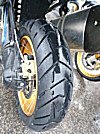
Tearing, graining, a blue sheen or a rough surface can be influenced by pressure, track temperature, compound, suspension, throttle use, tyre age and circuit abrasiveness. A photograph alone rarely proves one cause.
First confirm the pressure with a known gauge and the correct measurement method. Then consider whether the tyre reached its target temperature, whether the wear is on one side only, and whether recent suspension or geometry changes may be contributing. Make one change at a time; otherwise you will not know what improved or worsened the result.
Frequently asked questions
What are the best motorcycle tyres for a first track day?
A current road-legal sports or hypersport tyre in good condition is normally the most practical choice. It offers manageable warm-up, useful wet performance and enough capability for most novice-group riding. Correct pressures and confidence matter more than fitting the most extreme race tyre.
Can I use road tyres on a motorcycle track day?
Yes, provided the tyres are suitable for the motorcycle, in good condition and accepted by the organiser. Modern sports tyres are highly capable. Touring, adventure or other road tyres may also be acceptable at an appropriate pace, but seek advice if their intended use, condition or speed rating is uncertain.
Do I need slick tyres for the fast group?
Not automatically. Fast treaded track tyres can deliver very high performance and may suit a rider's setup or conditions better. Slicks become worthwhile when the rider can manage their temperature, pressure and setup consistently.
Can I ride to a track day on slick tyres?
No. Slicks marked NHS are not legal for public-road use. Use road-legal tyres or transport the motorcycle to the circuit.
Should I lower my motorcycle tyre pressures for a track day?
Often the recommended track setting differs from the road setting, particularly at the rear, but there is no universal amount to remove. Use the tyre manufacturer's model-specific track guidance and make sure you know whether its figure is cold, hot or measured off warmers.
How long do motorcycle track-day tyres last?
There is no fixed number of days. Life depends on pace, bike power, electronics, circuit, compound, setup, pressure, temperature and heat cycles. Inspect the tyre throughout the event and replace it when condition or performance is no longer satisfactory—regardless of how much tread appears to remain.
Is a softer tyre compound always better?
No. The softest compound may overheat, tear or wear quickly in the wrong conditions. The right compound is the one matched to the brand's temperature guidance, your pace, bike, circuit and session format.
Need help choosing your track-day tyres?
Tell the Sticky-Stuff team your motorcycle, tyre sizes, circuit, riding group, pace, whether you use warmers and whether you will ride to the event. We can help narrow the range and arrange fitting at our specialist motorcycle tyre centre in Telford.
Important: This guide is general information, not a substitute for the latest motorcycle, tyre manufacturer, circuit organiser or professional race-support instructions. Track riding carries significant risk. Check the exact product specification, condition, pressure and road legality before use.